01From possibilities to their organisation
In the previous chapter, we examined how declared conditions define an admissible set. We now add a question: how do we distinguish different forms of organisation within a system description, and what would be needed to establish a transition between them?
The Manifest places mechanical regimes and structural transitions within the theoretical development of FBM. It places regime partitions, transition graphs and stability within the mathematical monograph. These are connected subjects with different roles in the analysis.
Here we prepare that reading path with a small ideal-contact example. Its three categories are defined specifically for the example. The full definitions of FBM regimes belong to the corresponding monographs.
Connection to the corpus: Corpus Manifest v1.0, §§3.1–3.2, pp. 2–3 ↗
02Which change are we describing?
The statement “the system changed” needs to be completed. It may concern an observed value, a condition that we modify, or a distinction that we apply within our description.
| Question | What needs to be declared |
|---|---|
| Did a value change? | Which quantity is being compared and under which conditions. Two different values may belong to the same category. |
| Did a parameter or condition change? | Which part of the description was modified and how it affects the admissible possibilities. |
| Did the classification change? | Which specific criterion distinguishes the categories and what evidence shows that it is satisfied differently. |
The table organises the reading. In the geometric example of the previous chapter, we varied a parameter and examined the remaining set. Interpreting a change as a mechanical transition additionally requires connecting the criterion to the particular system and its evolution.
An original reading aid, continuing the chapter on frame, constraints and admissibility.
03A small ideal-contact model
Consider ideal rigid contact without friction or adhesion. Let g be the normal gap, positive when the bodies are separated. Let N be the magnitude of the compressive normal contact reaction: a force, measured in newtons.
g ≥ 0 · N ≥ 0 · gN = 0
Nonpenetration gives g ≥ 0. Absence of an attractive reaction gives N ≥ 0. Complementarity, gN = 0, rules out a positive reaction at a positive gap. The external source below presents this relation with different notation.
Contact relation: Russ Tedrake, Underactuated Robotics, “Multi-Body Dynamics”, subsection “Time-stepping LCP: Normal force” — the continuous-time relations before discretisation ↗
04Three categories with an explicit criterion
From the declared relations, we construct three local categories of pairs (g, N). A pair is a partial description: it does not include velocities or the remaining forces, for example.
| Category | Criterion | Reading the pair |
|---|---|---|
| S | g > 0, N = 0 | Positive gap, zero normal contact reaction. |
| C | g = 0, N > 0 | The bodies touch and the normal reaction is positive. |
| Z | g = 0, N = 0 | The bodies touch with zero normal reaction. |
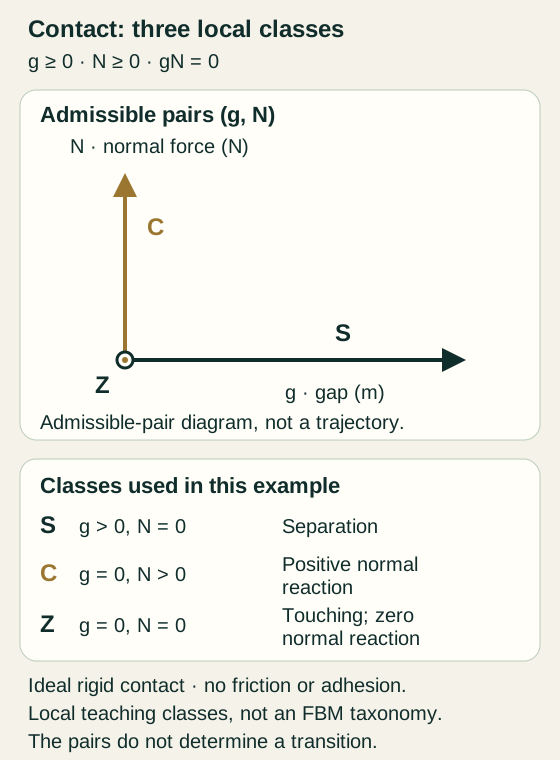
Z deserves particular attention: zero contact reaction does not mean that all external forces are absent. The criterion concerns only the two quantities we have selected.
Original development for this example, with local categories and notation. No empirical data or formal definitions of FBM regimes are presented.
05Same category, different values
Let us compare hypothetical pairs that satisfy the model. The following comparisons do not assume that the pairs are successive instants of the same motion.
| Pairs being compared | Result |
|---|---|
| (2 mm, 0 N) and (1 mm, 0 N) | Different gap, same category S. |
| (0 mm, 2 N) and (0 mm, 5 N) | Different reaction, same category C. |
| (0 mm, 2 N) and (0 mm, 0 N) | Same gap, different categories C and Z. |
The third comparison returns to the question of the trace. An observation of the gap alone records zero in both cases. Even a more precise measurement of that quantity would not distinguish these ideal pairs: the difference lies in the contact reaction.
The partition and the selected observation
Using local notation, define the set of pairs satisfying the relations:
M = { (g, N) : g ≥ 0, N ≥ 0, gN = 0 }
S = { (g, 0) : g > 0 }
C = { (0, N) : N > 0 }
Z = { (0, 0) }
Every element of M belongs to exactly one of S, C and Z. These therefore form a partition: M = S ∪ C ∪ Z, with pairwise empty intersections.
If we observe only the gap, define πg(g, N) = g. Every pair in C and the single pair in Z have the same image, zero. This observation does not distinguish the two categories. Adding N allows the distinction within this ideal model.
The partition follows from the definitions above. Determining how a physical system evolves requires further relations and data.
Original development for this example, with local categories and notation. No empirical data or formal definitions of FBM regimes are presented.
06What supports a transition claim?
The pair (0, 0) describes zero gap and zero normal reaction. By itself, it does not tell us whether the bodies are about to separate, have just met, or will remain in that condition. Its position in the diagram does not contain this temporal information.
To establish a category change during an actual evolution, we need to know which pairs belong to the same observed process and apply the same criterion at the instants being compared. A mechanical interpretation also requires appropriate equations of motion, velocities and, where needed, contact or impact laws.
The three algebraic relations do not determine the reaction, equilibrium or evolution by themselves. They are not an impact model; N here denotes force, not impulse.
A transition requires a declared classification criterion and evidence of a category change in the system under examination.
Four questions help when reading such a claim:
- Which system and conditions remain common to the comparison?
- Which criterion distinguishes the regimes being discussed?
- Which data show the change, and what exactly does each record measure?
- Which additional relations connect the observed change to the mechanical interpretation?
These questions are a reading guide. In an application, measurement uncertainty also needs consideration: exact equality to zero belongs to the ideal mathematical example.
Connection to the corpus: Corpus Manifest v1.0, §10, p. 6 · §§12–13, p. 7 ↗
07Continuing through theory, mathematics and the Atlas
The theoretical path turns to constraint organisation, dominance and regimes. The central question is which structural distinction supports the proposed interpretation.
In the mathematical path, partitions and transition graphs provide objects with which such organisation can be formulated. The simple partition in the example prepares the idea of explicit classification; the FBM development belongs to the mathematical monograph.
In the Atlas path, the Manifest places the empirical study of articulators, contact continuity, friction and dominance distribution. This page’s ideal model offers a reading exercise before we move to specific, documented cases. Its categories are not presented as an Atlas classification.
Connection to the corpus: Corpus Manifest v1.0, §§3.1–3.3, pp. 2–3 ↗
08Sources and further study
This chapter is a new introductory synthesis. References to the place of concepts within FBM and to the boundaries of claims are based on the public Corpus Manifest v1.0; section and page numbers refer to that text. The external source documents the standard ideal normal-contact relation. The S/C/Z classification, comparisons and diagram were developed for this page. The external literature does not validate FBM.