01First, identify what was recorded
A line on a surface, the path of a point or a sequence of positions on a screen can become a starting point for mechanical inquiry. To understand what it tells us, we first need to identify which quantity was observed and how it was recorded.
In this chapter, we use “trace” for the recorded result of a selected observation. This is an introductory description for the explanation that follows. A record might, for example, retain position along just one direction, while the full motion takes place in more than one.
Such a trace can help us describe and compare what was actually recorded, within the limits of the method. Attributing the observation to a particular structure adds a further question: which constraints and conditions made it possible?
The Manifest places this relationship between observable projection and structural identity at the centre of the corpus.
Basis for the discussion: Corpus Manifest v1.0, §2, p. 2 · §13, p. 7 ↗
02Three different levels of conclusion
Two similar traces can support a comparison of their shape. To avoid a leap in interpretation, it helps to distinguish three statements:
| Level | What we claim | What remains to be examined |
|---|---|---|
| Observation | The records agree for the quantity and conditions examined. | What was not recorded, and how precise was the comparison? |
| Compatibility | A declared description can agree with the result. | Do other descriptions also agree? |
| Structural attribution | The evidence supports attributing the result to a particular structure within a declared scope. | What supports that connection, and what are its limits? |
This table is a reading aid for the chapter. It develops the Manifest’s distinction between compatibility and attribution. An interpretation that fits a result has not automatically been established as its unique explanation.
Basis for the discussion: Corpus Manifest v1.0, §10, p. 6 ↗
03Two paths, one record
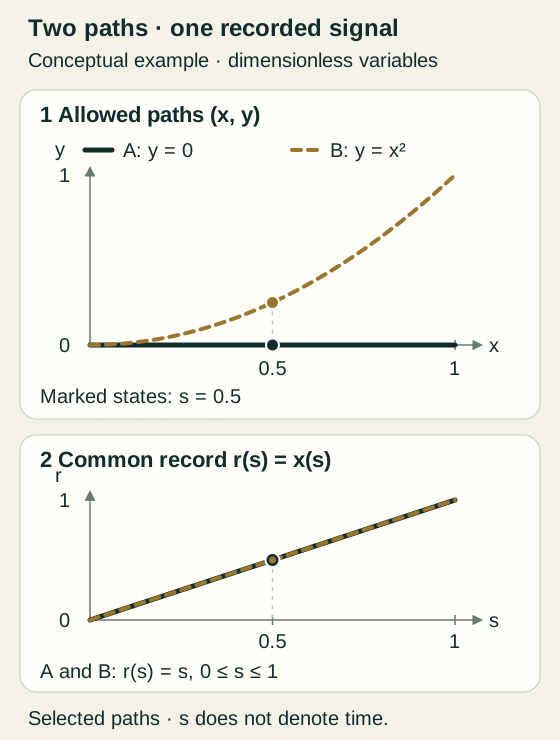
This example is a logical aid for examining information retained by a selected observation. Curves A and B are mathematically declared; they have not been identified as projections of two particular complete FBM structures. The theoretical starting point remains structure and its projection.
Suppose our observation retains only the horizontal coordinate x. We consider two declared geometric possibilities: in A, the points lie on the line y = 0; in B, they lie on the curve y = x2.
We select corresponding points with the same value of x. The records of horizontal position coincide, while the second coordinate differs for x > 0. Looking only at the record does not let us choose between these two possibilities.
The mathematical reading of the example
We use dimensionless coordinates and a common parameter s ∈ [0, 1]. The two sets of admissible geometric states are:
A = { (x, 0) : 0 ≤ x ≤ 1 }
B = { (x, x²) : 0 ≤ x ≤ 1 }
We choose the parameterisations qA(s) = (s, 0) and qB(s) = (s, s2). Here, the observation is defined as π(x, y) = x. Therefore:
π(qA(s)) = s = π(qB(s))
For s > 0, different states yield the same observation. At s = 0, the states coincide. The observation is not one-to-one on the union of the two sets.
Parameter s and the parameterisations were chosen for the comparison. The geometric constraints alone do not determine motion in time, forces or complete physical mechanical models.
Here π is a specific observation map from coordinate pairs to a single value. The notation belongs to this example. Properties of an observation map require its specific definition; here the loss of distinction follows from the explicit calculation.
Adding observation of y lets us distinguish this pair of hypotheses for s > 0. It is not a general guarantee that we have identified all constraints or the physical mechanism.
Basis for the discussion: Corpus Manifest v1.0, §10, p. 6 ↗ — basis for the projection / identity distinction. The example and its development are original to this page.
04What does a more precise record add?
In the example above, the records of x coincide exactly. Even an ideal measurement of that coordinate would leave the difference in y unseen. Increasing the precision of one quantity does not automatically add a different observable quantity.
This does not diminish the value of good measurement. It shows why we need to distinguish how well we record from which information we choose to record. For this particular pair, an additional coordinate is more discriminating than more digits in the same coordinate.
Nor does the example imply that traces are always insufficient for every question. When independent information and declared assumptions restrict the possible interpretations, a record can acquire greater discriminating value. The conclusion remains connected to that set of assumptions and observations.
This section develops the preceding conceptual example; it does not report an additional experimental finding.
05What is needed alongside the trace?
Inquiry progresses when a record is connected to the declared structure and to evidence that tests its interpretation. Useful questions for a reader include:
- What has been declared? Which system, constraints and conditions are being examined?
- What was observed? Which quantity does the record retain, and which information lies outside it?
- What agrees with the observation? Which alternative descriptions have actually been considered?
- What was checked independently? Which evidence supports the connection between the proposed structure and the physical situation?
- How far does the conclusion extend? Within which domain, under which assumptions and with which evidential limits?
These are orientation questions, not a universal validation protocol. The appropriate evidence depends on the claim and the domain.
The Manifest also distinguishes internal validation from agreement with physical reality. A result’s consistency with a declared description and the examination of whether that description corresponds to the physical system are different questions.
Basis for the discussion: Corpus Manifest v1.0, §10, p. 6 · §§12–13, p. 7 ↗
06The place of the trace in the Atlas
In the articulator domain, the Atlas examines trace behaviour alongside dominance distribution, contact continuity, friction and structural validation. This description of its scope in the Manifest suggests a way to organise our reading: look for the relationship between the appearance of a trace and the mechanical conditions accompanying it.
Similarity between two images is a particular observation. Maintaining contact or organising constraints raises different questions, each requiring relevant evidence. Their mention here introduces the subject matter of the monograph; it does not establish acceptance criteria for arbitrary systems.
Basis for the discussion: Corpus Manifest v1.0, §3.3, p. 3 · §12, p. 7 ↗
07A statement that respects the evidence
Our conceptual example supports a specific result:
The two selected paths give the same record of horizontal position. This particular observation is insufficient to choose between the two declared geometric hypotheses.
This statement identifies what was examined and what remains open. It concludes neither structural equivalence nor a general inability to know the system.
A trace takes its place in an evidence-supported mechanical interpretation in this way: it contributes information within a declared observation, while its connection to structure rests on the evidence accompanying the particular claim.
Basis for the discussion: Corpus Manifest v1.0, §10, p. 6 · §13, p. 7 ↗
08Sources and further reading
This chapter is a new explanatory synthesis for the website. It draws on the distinctions and claim boundaries in the public Manifest v1.0. Section and page numbers refer to the Manifest. The figure, geometric example, table and reading questions were created for this page.
For full theoretical development, mathematical formalisation and empirical study, continue to the respective monographs: